Insights & Stories
Bedell Journal & Blog
Stories of Craftsmanship, Sound & Stewardship
Exploring Rainforest Stewardship & Acoustics
A guitar begins with a living material, not merely a polished piece of wood. For players, tonewood affects resonance, weight, grain, stability, and long-term repairability. Certified Sustainable Tonewood Guitars connect these musical qualities with documented forest responsibility. The word “certified” matters. It should identify a verifiable supply chain, not simply attractive environmental language.
The FAO Global Forest Resources Assessment 2020 reported that approximately 420 million hectares of forest disappeared between 1990 and 2020. Forest loss has slowed, but pressure remains uneven across regions and species. FSC Facts and Figures reports more than 160 million hectares of certified forests worldwide. These figures do not prove that every certified guitar is automatically sustainable. They show why certification, chain-of-custody records, and species documentation deserve attention. CITES regulations also demonstrate that certain timber species require careful international controls and traceability.
In a workshop, responsible sourcing becomes tangible. A supplier should provide the wood species, origin, certification number, and supporting documentation. The neck blank should not be a mystery. The same principle applies to ebony fingerboards, rosewood bridges, and maple tops. Certification can reduce sourcing risks, support responsible forestry, and give musicians clearer purchasing evidence. It cannot replace skilled construction, honest labeling, or independent verification.
Some claims remain difficult to compare. That is the uncomfortable part. A careful buyer should ask questions. The strongest choice combines trusted certification, transparent suppliers, durable craftsmanship, and realistic environmental claims. This approach makes Certified Sustainable Tonewood Guitars more than a marketing phrase; it makes them a measurable step toward better-informed musicianship.
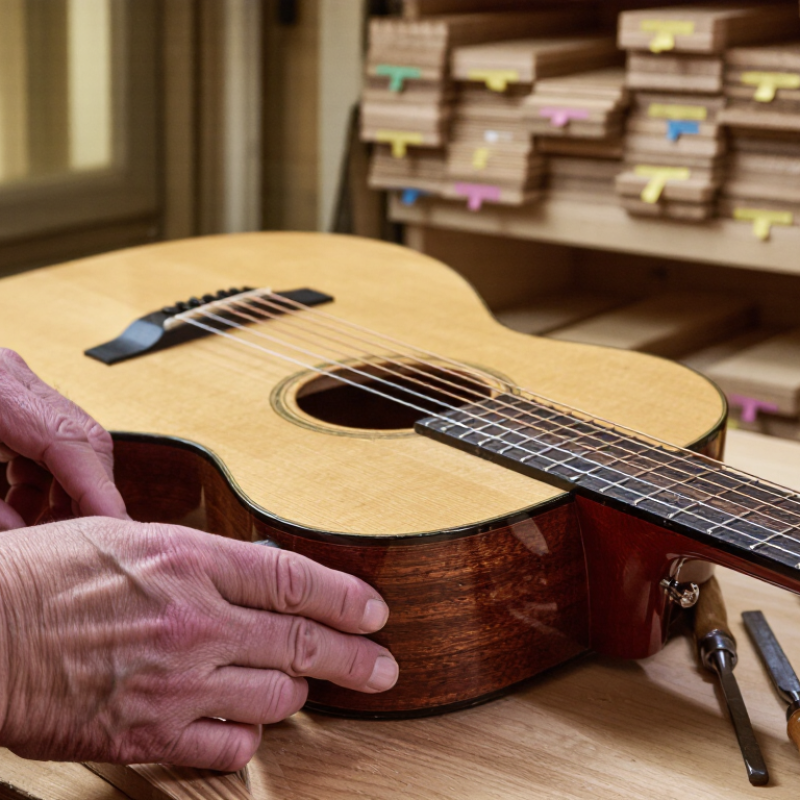
Certified sustainable tonewood is not simply wood with a green label. It refers to timber tracked from a responsibly managed forest to the workshop. Certification can verify harvest permissions, species records, transport documents, and chain of custody. Independent audits add useful evidence, although no system removes every risk. In my experience, clear paperwork often reveals more than polished marketing claims. That detail matters.
A certified board may come from a forest with regeneration plans, habitat protections, and limits on annual cutting. Some schemes also require worker safeguards and community consultation. However, certification rules differ, so check the certificate’s scope, date, and product coverage. Sustainable is not permanent. Forest conditions change, and supply chains can develop gaps. I would rather see an honest limitation than an exaggerated promise. The wood still needs careful drying and skilled construction for reliable tone.
Tips: Ask for the certification body and certificate number. Verify them through an official public database. Check the listed species and harvest region. Confirm whether certification covers the guitar, the wood supplier, or only the forest. Ask about reclaimed or locally available alternatives when suitable. These questions may feel demanding. They also help separate traceable materials from attractive but uncertain claims.
Certified sustainable tonewood guitars begin with traceable wood, not attractive grain alone. In a workshop, I look beyond color and resonance. I also ask where the wood was harvested, processed, and documented.
A credible certification system checks legal ownership, harvest permits, species records, and supply-chain transfers. Auditors may compare forest documents with mill invoices and transport records. Chain-of-custody controls then follow the wood toward the guitar maker. This evidence reduces the chance of mixed or falsely labeled material. Certification is not magic. Audits often examine samples, and paperwork can still contain errors. That limitation deserves honest attention.
Tips: Ask for the certification scope and current certificate number. Check whether it covers the forest, mill, and guitar maker. Request details about the wood species and origin. Keep the questions specific. Vague answers are worth noticing.
Responsible sourcing also considers forest regeneration, worker safety, and local community rights. A tonewood may be legally harvested yet poorly managed. That difference matters. I have seen beautifully figured pieces raise questions when origin records were incomplete. A careful buyer should accept that uncertainty, pause, and verify. Small details, such as matching batch numbers on invoices and labels, can reveal whether a guitar’s story is reliable.
| Verification Dimension | What Certification Checks | Typical Evidence | How It Supports Responsible Sourcing | Important Limitation |
|---|---|---|---|---|
| Legal harvest authorization | Whether the timber was harvested under the applicable national and local forestry laws. | Harvest permits, concession records, transport documents, and government-issued licenses. | Reduces the risk of timber entering the supply chain through unauthorized harvesting. | A certificate does not replace import, export, customs, or protected-species requirements. |
| Forest management practices | Whether forest operations address regeneration, biodiversity, soil, water, worker safety, and community interests. | Forest management plans, ecological safeguards, worker procedures, and field-audit findings. | Connects the tonewood to broader environmental and social management requirements. | Certification standards differ; buyers should review the scope and applicable standard. |
| Chain of custody | Whether certified material can be tracked through harvesting, processing, trading, and guitar production. | Supplier certificates, purchase and sales invoices, batch records, inventory controls, and transaction records. | Helps prevent certified and uncertified materials from being incorrectly represented as the same product. | The finished guitar is covered only when the relevant suppliers and production sites fall within the certified scope. |
| Species identification | The declared botanical species and, where required, the scientific name used in trade documentation. | Species declarations, supplier specifications, botanical references, and documentation for regulated species. | Improves accuracy when a species has trade restrictions, conservation concerns, or regional legal controls. | Visual inspection alone may not reliably distinguish closely related wood species. |
| Geographic origin | The country or region where the wood was harvested and the route it followed before manufacture. | Country-of-origin records, shipping documents, supplier declarations, and traceability logs. | Allows risk assessment against local forestry laws, protected areas, sanctions, and trade restrictions. | A country of origin is not, by itself, proof that every harvesting activity was legal or sustainable. |
| Protected-species compliance | Whether internationally or nationally protected species are traded with the required authorization. | CITES permits where applicable, export and import documents, and species-specific declarations. | Supports lawful trade in restricted tonewoods and helps address conservation risks. | CITES applies only to listed species and populations; non-listed wood may still be subject to other laws. |
| Independent auditing | Whether an independent conformity-assessment body evaluates documented procedures and selected field or site evidence. | Audit reports, corrective-action records, surveillance audits, and certificate status information. | Adds external review instead of relying solely on a supplier’s self-declaration. | Audits use sampling and cannot guarantee that every individual board has been physically inspected. |
| Social safeguards | Whether operations address worker rights, occupational safety, Indigenous peoples’ rights, and affected communities. | Labor policies, safety records, consultation evidence, grievance procedures, and audit interviews. | Broadens sustainability beyond forest cover to include people affected by forestry activities. | The depth of social requirements depends on the certification standard and local legal context. |
| Certificate validity and scope | Whether the certificate is current and covers the correct forest, supplier, processing site, product category, and claim. | Certificate number, issue and expiry dates, authorized sites, product scope, and certification status. | Prevents a valid certificate from being applied to an unrelated facility, material, or product. | Purchasers should verify the certificate directly in the relevant public certification database. |
| Due diligence support | Whether available records help buyers assess legality, origin, species risk, and supply-chain risk before purchase. | Risk assessments, supplier questionnaires, document reviews, mitigation actions, and retained transaction records. | Provides a stronger documentation base for responsible procurement and regulatory compliance. | Certification is evidence for due diligence, not a universal exemption from national import or market-access rules. |
Environmental Benefits of Choosing Sustainable Tonewood Guitars
Certified sustainable tonewood can reduce pressure on vulnerable forest ecosystems. The FAO’s Global Forest Resources Assessment 2020 reports that forests declined by about 420 million hectares between 1990 and 2020. However, annual forest loss slowed from 16 million hectares to 10 million hectares during those periods. Responsible sourcing supports this progress through verified harvesting and replanting practices.
Certification also improves material traceability. A documented chain of custody can connect a guitar’s wood to a managed forest, sawmill, and workshop. This matters when builders select maple, spruce, or rosewood for a specific sound. In a small workshop, traceable wood may mean fewer questionable purchases, less waste, and better planning around kiln-dried stock. The environmental benefit becomes tangible: fewer discarded blanks and more efficient use of each board.
The picture is not perfect. Certification does not erase transport emissions, kiln energy, or manufacturing waste. The International Energy Agency reports that industry remains a major global source of energy-related carbon dioxide emissions, so wood choices alone cannot solve the problem. Buyers should examine current certificates, species information, and supply-chain records. A beautifully finished instrument can still carry hidden impacts. Better decisions require honest questions, not just attractive labels.
Global annual net forest loss declined from approximately 7.8 million hectares per year in 1990–2000 to 4.7 million hectares per year in 2010–2020. Choosing certified sustainable tonewood supports responsible forest management, legal sourcing, supply-chain traceability, and the protection of forest ecosystems.
Source: FAO, Global Forest Resources Assessment 2020. Figures represent global annual net forest loss.
Certified sustainable tonewood can affect a guitar before the first note is played. Responsible sourcing protects forests, while material choice influences structure, resonance, and long-term stability. Certification provides traceable evidence about origin and handling. It does not guarantee a perfect instrument. That distinction matters.
In workshop evaluation, luthiers examine density, grain direction, moisture content, and stiffness. A well-seasoned soundboard may respond quickly, producing clear attack and balanced sustain. Stable neck wood helps the instrument hold its setup through changing humidity. Poorly dried wood can swell, shrink, or develop small cracks. The result is frustrating. Sustainable wood is not automatically lighter, louder, or warmer. Each piece behaves differently.
Performance also depends on bracing, construction, finish, strings, and playing technique. This is where careful testing becomes essential. Two guitars made from similar certified materials may still feel and sound unlike each other. Players should listen for note separation, sustain, intonation, and comfort, not just read a sourcing label. I would question vague environmental claims, too. Reliable documentation should identify the material, certification scope, and chain of custody. That extra checking takes time. It can prevent expensive disappointment.
A certification mark is useful, but it is not the whole story. Check the certificate number, issuing organization, validity period, and covered materials. The document should connect the guitar to a traceable supply chain. A label alone proves little. Ask directly.
Look closely at the wood description. Does it identify the species and origin? Does it mention responsibly harvested, reclaimed, or recycled material? These terms are not interchangeable. A seller should explain how the soundboard, neck, fingerboard, and bridge were sourced. If the answer sounds vague, pause before paying. Reliable sellers usually provide paperwork, not only attractive environmental language.
I once judged a guitar by its warm tone and neat finish, then overlooked its incomplete sourcing details. That was careless. Play every fret and listen for uneven volume, buzzing, or weak sustain. Examine the bridge, neck joint, finish, and internal bracing with proper light. Certified materials cannot compensate for poor construction. Also ask how the instrument was stored and shipped, because humidity changes can cause cracks. Some certificates cover only the wood, not every component. That limitation deserves attention. Compare the claims with independent records when possible, and keep copies of invoices and certification details after purchase.
It means the wood is tracked from a responsibly managed forest to the guitar workshop.
It may verify harvest permissions, species records, transport documents, and chain-of-custody records.
No. Certification reduces uncertainty, but it cannot remove every environmental or supply-chain risk.
Ask for the certification body, certificate number, listed species, harvest region, and product coverage.
A certificate may cover the forest, wood supplier, or complete guitar. These scopes are different.
Verified harvesting, regeneration plans, habitat protections, and cutting limits can reduce pressure on vulnerable ecosystems.
It can support better planning, fewer questionable purchases, and more efficient use of kiln-dried boards.
No. Transport, kiln energy, and manufacturing waste still create impacts. The picture remains incomplete.
Not automatically. Careful drying and skilled construction still determine reliability, response, and tone.
It can feel demanding. Yet clear paperwork often says more than polished marketing.
Certified Sustainable Tonewood Guitars are made with wood sourced through responsible forestry practices and supported by recognized certification standards. Certification helps verify that the timber is legally harvested, traceable through the supply chain, and managed with attention to forest regeneration, biodiversity, and local communities. Choosing these guitars can reduce pressure on vulnerable forests while encouraging manufacturers and suppliers to adopt more transparent and environmentally responsible methods.
Sustainable materials do not necessarily compromise sound or playability. When carefully selected, properly dried, and expertly crafted, certified tonewood can provide excellent resonance, stability, durability, and visual character. Before buying, customers should review the certification details, confirm the wood species and source, examine the builder’s supply-chain transparency, and compare construction quality, tone, comfort, and long-term maintenance needs. In this way, buyers can choose an instrument that combines dependable performance with more responsible material choices.