Bedell Guitars Blog — Insights on Acoustic Craftsmanship & Sustainable Tonewoods

Insights & Stories

Bedell Journal & Blog

Stories of Craftsmanship, Sound & Stewardship

Seed-To-Song

Tonewood Articles

Exploring Rainforest Stewardship & Acoustics

0%

Choosing among the top Handcrafted Solid Wood Guitars suppliers worldwide requires more than attractive photographs and polished descriptions. A serious evaluation begins with construction details, workshop experience, and consistent customer evidence. Solid spruce, cedar, mahogany, rosewood, and maple each create different tonal responses. The wood must also be properly seasoned and protected from rapid humidity changes.

Andrés Segovia famously said, “The guitar is a small orchestra.” His words explain why small building decisions matter. A carefully voiced soundboard can produce warm bass, clear mids, and singing treble. Bracing shape, neck angle, fretwork, bridge placement, and finish thickness also influence comfort and projection. These details separate a genuinely skilled workshop from a supplier that simply uses impressive language.

This guide examines respected suppliers through practical, buyer-focused standards. It considers material transparency, luthier qualifications, workshop methods, quality control, repair support, and international shipping practices. Customer reviews can reveal useful patterns, especially when they mention tuning stability, fret edges, setup accuracy, and packaging condition. They are not perfect evidence.

No ranking is flawless.

Some smaller makers have limited online visibility but exceptional instruments. Others look authoritative while offering little technical information. That uncertainty deserves attention. Buyers should request wood specifications, construction photographs, warranty terms, and climate-care guidance before ordering. A handcrafted guitar is not only a product; it is a sensitive wooden instrument shaped by human judgment, regional traditions, and years of adjustment. The strongest suppliers communicate those realities honestly, even when their processes are slower and less predictable.
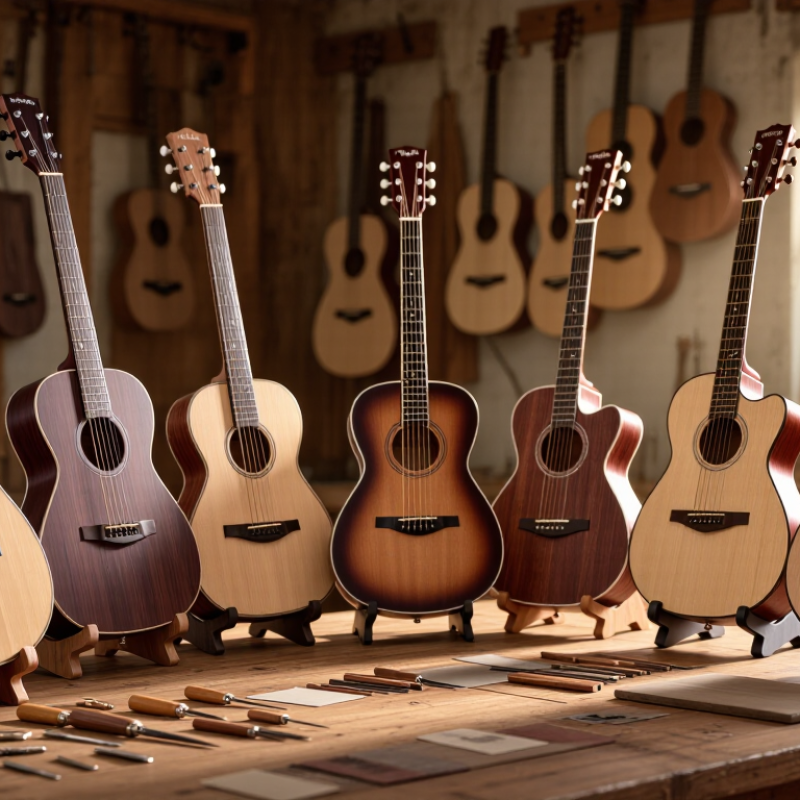
Top Handcrafted Solid Wood Guitars Suppliers Worldwide

Defining Handcrafted Solid Wood Guitars and Their Key Features

A handcrafted solid wood guitar is built with solid timber for its soundboard, back, and sides. Unlike layered construction, solid wood responds to vibration throughout its grain. This often creates a richer, more complex voice as the instrument matures. “Handcrafted” also means more than visible decoration. It describes careful shaping, joining, bracing, sanding, and final adjustment by skilled makers.

The soundboard usually influences projection and sensitivity most strongly. Its grain should appear consistent, while the thickness must remain carefully balanced. Internal bracing supports the top without making it stiff. A well-voiced guitar can respond to a gentle finger touch and remain clear during stronger strumming. The neck should feel stable, with smooth fret edges and accurate spacing. These details reveal practical workmanship.

Wood selection affects tone, weight, appearance, and long-term stability. Spruce may offer quick response, while cedar often feels warmer under light playing. Rosewood-like dense woods can add depth, but they may increase weight. Climate matters too. Rapid humidity changes can cause cracks, lifting bridges, or unstable action. Regular inspection is essential.

Not every expensive-looking guitar is well made. That is worth remembering. Hand finishing can leave small visual variations, and perfection is not always the goal. A careful buyer should examine the bridge fit, fretwork, neck alignment, and finish thickness. I have found that a slightly imperfect surface can matter less than reliable tuning, comfortable playability, and an honest, responsive tone.

Materials, Construction Methods, and Craftsmanship Standards

Top Handcrafted Solid Wood Guitars Suppliers Worldwide

Reliable suppliers begin with traceable tonewoods, not attractive photographs. Solid spruce, cedar, maple, mahogany, and rosewood each respond differently to vibration, humidity, and time. Experienced builders should identify the wood species, grade, origin, and seasoning method clearly. Quarter-sawn grain usually improves stability, but it does not guarantee superior tone.

Moisture control matters greatly. Many workshops store timber near 40–50% relative humidity before construction. I look for straight grain, tight joints, and clean glue lines around the soundboard and braces. Hand-scalloped bracing can increase responsiveness, yet excessive carving may weaken the top. Small details matter. A thin finish preserves resonance, while a heavy finish may protect the surface but reduce sensitivity.

Construction quality appears in the neck angle, fret leveling, bridge placement, and internal reinforcement. Skilled suppliers measure action at the twelfth fret and inspect intonation across the fingerboard. Traditional dovetail joints can be strong, while modern bolt-on systems may simplify future repairs. Neither method is automatically better. Craftsmanship standards should include final inspection records, controlled setup procedures, and consistent dimensional tolerances.

Standards still vary.

A supplier may describe every instrument as “master grade,” although that phrase has no universal definition. Buyers should request clear photographs, wood documentation, humidity guidance, and repair policies. Even careful makers miss things. A tiny finish mark may reveal rushed polishing, or simply reflect honest handwork. The important question is whether the workshop notices, records, and corrects such imperfections.

Top Handcrafted Solid Wood Guitars Suppliers Worldwide

Materials, Construction Methods, and Craftsmanship Standards

Materials

Spruce and cedar are commonly selected for soundboards because of their favorable strength-to-weight ratio. Mahogany, rosewood, and maple are widely used for backs, sides, and necks.

Construction Methods

Handcrafted instruments typically combine bookmatched solid plates, bracing, dovetail or bolt-on neck joints, careful voicing, and thin protective finishes.

Craftsmanship Standards

Professional quality checks commonly include stable humidity control, accurate fretwork, consistent neck relief, clean joints, and final playability inspection.

The chart shows approximate air-dry density ranges for commonly used guitar woods. Actual density varies with species, growth conditions, moisture content, and individual instrument stock.

How to Evaluate Worldwide Guitar Suppliers and Their Workshops

When evaluating worldwide suppliers of handcrafted solid wood guitars, inspect the workshop behind the catalog. Ask how long the wood has been seasoned and how humidity is controlled. A reliable workshop should record temperature and moisture levels, not merely promise “premium wood.” Look for clear photographs of bracing, neck joints, bridges, and finishing areas. These details reveal more than polished product images.

Request a sample guitar or an independent inspection. Check whether the neck remains stable after transport across climates. Examine fret edges, bridge alignment, saddle height, and action at the twelfth fret. Play individual notes and full chords. The instrument should respond evenly, with clean sustain and no unexplained buzzing. A skilled supplier can explain its bracing pattern, setup tolerances, repair process, and expected maintenance. Vague answers deserve caution.

Ask for wood-origin records, workshop references, production timelines, and written quality standards. Confirm that the supplier protects instruments with suitable cases, moisture control, and careful packaging. Communication matters too. Replies should be specific, consistent, and easy to verify. I have trusted beautiful photographs before. That was a mistake. One supplier may build excellent guitars but lack dependable export packing. Another may communicate quickly but provide weak setup work. Compare several samples, not promises. A short video call with the actual craftsperson can expose gaps between marketing and daily practice. Even experienced buyers can misjudge tone from recordings, so allow room for uncertainty and test the guitar in person whenever possible.

Regional Supplier Profiles and Distinctive Guitar-Making Traditions

Regional suppliers reveal how climate, materials, and workshop habits shape solid wood guitars. Spanish workshops often favor European spruce tops with carefully voiced interiors. European spruce gives clear attack and responsive dynamics. Small makers may hand-shape braces for each instrument. That variation is intentional. Buyers should inspect grain direction, joint precision, and finish thickness. Photographs rarely show these details clearly.

In North America, suppliers commonly build with spruce, maple, walnut, and mahogany. Local traditions value projection, durability, and practical neck design. Some workshops use computer-controlled cutting, then complete voicing by hand. Brazilian suppliers often work with locally available tonewoods and warm, resonant construction methods. These woods can produce strong bass and complex overtones. However, dense timber may increase weight and require longer seasoning. Ask for moisture-control records and material traceability.

Japanese workshops often combine precise tooling with patient hand-finishing. Their suppliers emphasize stable neck geometry and exceptionally clean fretwork. Across regions, reliable suppliers explain wood selection without exaggerated claims. A good specification should include wood thickness, curing practice, bracing style, and humidity guidance. One weakness remains: even skilled makers can produce slightly different voices. That is not always a defect. It deserves careful listening, not automatic rejection. Suppliers earn trust through consistent measurements, honest tolerances, and clear responses when an instrument needs adjustment.

Top Handcrafted Solid Wood Guitars Suppliers Worldwide - Regional Supplier Profiles and Distinctive Guitar-Making Traditions

Region Typical Solid-Wood Materials Distinctive Guitar-Making Tradition Common Construction Features Typical Market Strength Important Sourcing Considerations
North America Sitka spruce, Engelmann spruce, Adirondack spruce, western red cedar, maple, walnut, mahogany Large-bodied steel-string guitars, detailed voicing, and strong emphasis on projection and dynamic range X-bracing, dovetail neck joints, scalloped bracing, hand-voiced soundboards, and traditional hide- or modern wood-glue assembly Premium steel-string acoustics, custom instruments, fingerstyle guitars, and bluegrass-oriented models Responsible forestry certification, grading consistency, moisture control, and documentation for restricted species
Spain and the Iberian Peninsula European spruce, western red cedar, cypress, Indian rosewood, maple, and mahogany Classical and flamenco guitar traditions based on light construction, fast response, and carefully balanced trebles and basses Fan bracing, Spanish heel construction, thinner tops, raised or traditional classical neck geometry, and shellac French polishing Handcrafted classical, flamenco, and concert guitars Species legality, provenance of rosewood, consistent top thickness, and specialist setup for nylon strings
Central Europe European spruce, alpine spruce, maple, walnut, pearwood, ebony, and European beech for selected structural parts Highly precise small-workshop lutherie with careful tap-tuning, symmetrical construction, and refined finishing Traditional dovetail or mortise-and-tenon joints, carved or shaped braces, thin finishes, and strong attention to neck stability Custom steel-string, classical, archtop, and chambered acoustic instruments Seasoned alpine spruce grading, workshop climate control, traceable hardwoods, and compliance with European timber regulations
United Kingdom and Ireland European and Sitka spruce, cedar, mahogany, walnut, maple, rosewood, and locally sourced sycamore Boutique steel-string craftsmanship combining traditional hand voicing with modern ergonomic design Fingerstyle-oriented voicing, compact body shapes, forward-shifted or scalloped X-bracing, and thin natural finishes Fingerstyle guitars, small-bodied acoustics, and bespoke commission work Humidity resilience, sustainable local timber, reclaimed wood documentation, and long-term neck and bridge stability
Japan Spruce, cedar, maple, mahogany, rosewood, and carefully selected domestic woods such as Japanese maple and cherry Meticulous small-scale craftsmanship influenced by both Western guitar construction and Japanese precision woodworking Highly accurate fretwork, clean binding, thin lacquer or oil finishes, carefully graduated tops, and detailed internal inspection High-end steel-string, classical, archtop, and limited-production custom guitars Strict material grading, export paperwork for protected woods, finish curing, and protection against shipping-related humidity changes
Australia and New Zealand Blackwood, Australian mahogany, Tasmanian blackwood, Queensland maple, spruce, cedar, and New Zealand-grown tonewoods Use of distinctive native timbers alongside imported soundboard woods, often with strong visual figure and regional character Steel-string X-bracing, modern body shapes, native-wood backs and sides, and hand-applied low-build finishes Boutique steel-string guitars, custom builds, and visually distinctive native-timber instruments Native forest management, plantation or reclaimed sources, quarantine rules, and accurate declaration of timber species
South America Brazilian cedar, mahogany, pau ferro, walnut, spruce imports, and legally documented rosewood where permitted Strong classical, folk, and popular-music traditions, with growing interest in locally sourced woods and sustainable alternatives Fan or hybrid bracing, nylon- and steel-string formats, lightweight construction, and regionally adapted body designs Classical, folk, crossover, and custom guitars using distinctive regional timbers CITES requirements for listed Dalbergia species, forestry permits, chain-of-custody records, and legal export documentation
Southeast Asia Spruce and cedar soundboards, mahogany, maple, ebony, Indian rosewood, and other legally sourced plantation or regional hardwoods Combination of established European and North American guitar methods with efficient workshop production and detailed ornamental work X-bracing and fan-bracing options, laminated structural components in some production lines, hand-levelled frets, and polished lacquer finishes Export-oriented solid-top and all-solid acoustic guitars, custom orders, and made-to-specification production Verification that “solid wood” applies to the stated components, timber legality, humidity control, consistent seasoning, and independent quality inspection

Note: Material choices and construction methods vary by workshop and model. Protected or regulated species should be verified through current CITES, forestry, and import-export documentation.

Pricing, Customization, Quality Control, and Export Considerations

Top Handcrafted Solid Wood Guitars Suppliers Worldwide

Pricing depends on more than wood species. Skilled labor, timber curing time, bracing design, hardware, and finishing all affect the final quote. A supplier should explain each cost clearly. Ask for pricing at different quantities, sample charges, packaging fees, and shipping terms. A low price may look attractive. It can also signal rushed drying or inconsistent craftsmanship.

Customization works best through written specifications. Confirm body shape, scale length, neck profile, fret size, bracing pattern, finish, and pickup options. Request a detailed drawing before production begins. Small changes matter. A slightly different neck width can alter playability. I would also request one approved sample, although samples cannot reveal every production risk. That limitation deserves attention.

Reliable quality control includes moisture testing, fret inspection, bridge alignment, finish checks, and acoustic testing. Solid wood should usually reach a stable moisture range before assembly, based on the supplier’s climate and technical standards. Ask for inspection photos, measurement records, and a pre-shipment report. Export planning requires protective cartons, humidity control, accurate invoices, and legally compliant wood documentation. Confirm Incoterms, insurance responsibility, customs requirements, and destination regulations in writing. An independent inspection can cost extra, but it may prevent expensive surprises.

FAQS

How can I evaluate a worldwide guitar supplier?

Inspect the workshop, not only the online catalog. Ask for wood-seasoning records, humidity logs, and clear construction photographs. Beautiful images can mislead.

What workshop details should I request?

Request photographs of bracing, neck joints, bridges, and finishing areas. Ask about temperature control and moisture readings. Vague promises deserve caution.

Should I request a sample guitar or inspection?

Yes, whenever possible. Check neck stability after climate changes, fret edges, bridge alignment, saddle height, and twelfth-fret action. Small flaws matter.

How can I test a guitar’s playing quality?

Play single notes and full chords. Listen for even response, clean sustain, and unexplained buzzing. Test both quiet and strong playing.

Which documents should a reliable supplier provide?

Ask for wood-origin records, workshop references, production timelines, and written quality standards. Material traceability supports trust. Records may still require independent checking.

How should instruments be protected during shipment?

Suitable cases, moisture control, and careful packaging are essential. Ask how the workshop protects guitars across different climates. Export packing can be a weak point.

Do regional traditions affect solid wood guitars?

Yes. Different regions favor different woods, bracing methods, and finishing habits. Spruce may offer clear attack, while dense woods can add weight and complex overtones.

What should I know about handmade variation?

Two skilled makers may produce different voices. That is not automatically a defect. Listen carefully, compare samples, and accept some uncertainty. I have misjudged tone from recordings before.

Conclusion

Handcrafted Solid Wood Guitars are valued for their resonant tone, natural character, and careful individual construction. This guide explains how carefully selected tonewoods, traditional joinery, bracing patterns, hand shaping, and refined finishing methods influence sound, durability, and playability. It also outlines practical craftsmanship standards, including wood seasoning, structural consistency, fret accuracy, surface quality, and final setup.

Choosing a worldwide supplier requires more than comparing prices. Buyers should evaluate workshop experience, material sourcing, production transparency, quality-control procedures, customization options, communication, and export preparation. Regional makers may reflect distinctive traditions in body design, ornamentation, voicing, and construction techniques, offering a broad range of musical possibilities. The guide also considers pricing factors, custom specifications, inspection processes, packaging, documentation, shipping reliability, and after-sales support, helping musicians, retailers, and distributors make informed decisions when selecting dependable handcrafted instruments.

Clara

Clara

Clara is a dedicated marketing professional with a strong understanding of the company’s products, customers, and industry landscape. Through her practical experience and thoughtful research, she transforms complex product information into clear, useful, and engaging content for both professional......