Insights & Stories
Bedell Journal & Blog
Stories of Craftsmanship, Sound & Stewardship

Choosing a sustainable acoustic guitar means looking beyond a “green” label. Buyers should ask what the instrument is made from, where its wood comes from, and how long it can be repaired and played. Small details matter: a documented wood source, a replaceable component, or a durable finish can say more than vague environmental promises.
The Food and Agriculture Organization’s Global Forest Resources Assessment 2020 reports that 420 million hectares of forest were lost through deforestation between 1990 and 2020. This figure covers forests worldwide; it does not mean guitar making caused that loss. Still, it gives buyers a reason to examine material sourcing carefully. Taylor Guitars co-founder Bob Taylor has expressed the value of responsible wood use this way: “The best way to save a tree is to make it valuable.” That idea is useful, though not a complete sustainability test.
This guide introduces 10 makers for buyers exploring Sustainable Acoustic Guitar Manufacturing. It considers wood transparency, reclaimed or alternative materials, production practices, repairability, and the information each company shares. Look for specifics, not just attractive claims. A maker may use responsibly sourced wood yet offer limited details about finishes or factory operations. That is worth noticing. No guitar is impact-free, and sustainability claims can be difficult to compare. The aim here is a more informed shortlist, not a perfect answer.
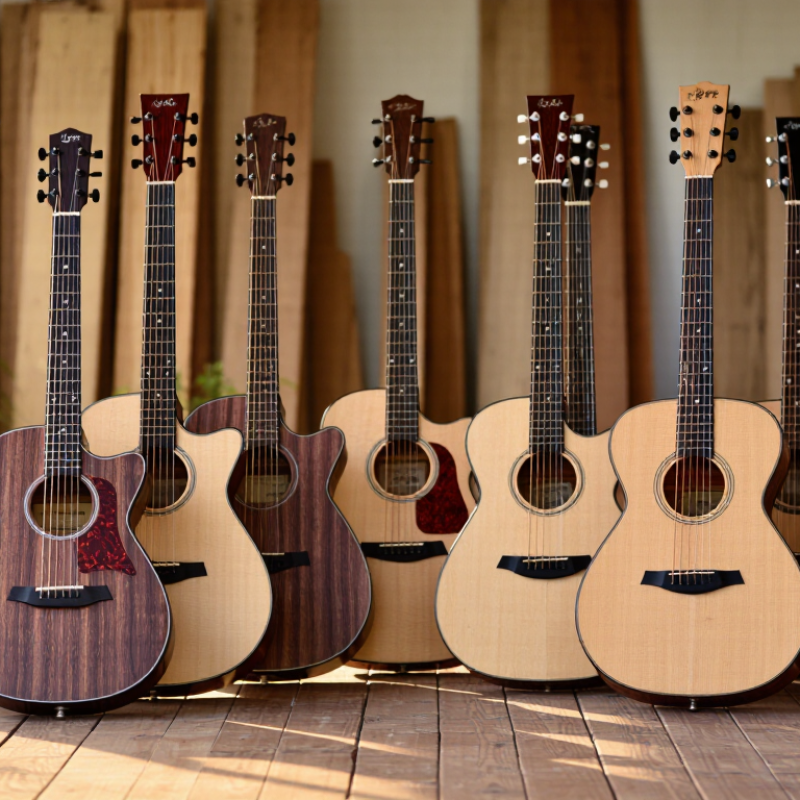
Top 10 Sustainable Acoustic Guitar Makers for Buyers?
Defining Sustainable Acoustic Guitars: FSC Chain-of-Custody Standard FSC-STD-40-004
An acoustic guitar may use responsibly sourced wood, but buyers need more than a sustainability claim. FSC-STD-40-004 sets requirements for tracking eligible FSC-certified material through processing, manufacturing, and sale. This chain of custody helps connect forest-origin materials to a finished product. It does not certify every part of a guitar or prove that its entire production has a low environmental impact.
For buyers, check whether the maker’s certificate is current and covers the relevant products and activities. Ask what FSC claim appears on the product paperwork, such as an invoice. A certificate alone may not mean every guitar contains certified wood. Hardware, finishes, adhesives, and workshop energy may fall outside the wood claim. Details matter. Paperwork can feel tedious, and even careful buyers may find claims hard to compare. That is worth acknowledging.
Tips: Ask which wood components are covered, and request documentation for the specific model. Look for clear, consistent claims across product information and sales documents. A neat label is useful, but evidence is better.
Buyer checklist, not a ranked list of manufacturers. Use these criteria to compare makers; the table does not imply that any particular maker or instrument is certified.
| No. | Sustainability dimension | What to verify | Useful evidence | Buyer interpretation |
|---|---|---|---|---|
| 1 | FSC chain of custody | Check whether the maker’s relevant facility has a valid FSC chain-of-custody certificate and whether the specific instrument or material is covered by an eligible FSC claim. | Certificate code, current certificate status, product documentation, and applicable sales or transaction records. | FSC-STD-40-004 sets requirements for organizations handling FSC-certified material through sourcing, processing, labeling, and sale. A company certificate alone does not establish that every guitar it makes is FSC-certified. |
| 2 | FSC claim and label clarity | Look for the exact claim associated with the wood, such as FSC 100%, FSC Mix, or FSC Recycled, and confirm which product or component it applies to. | On-product label or documented product claim, supported by valid certification and sales documentation. | FSC claims have specific meanings under the FSC system. Do not assume an FSC claim for one material applies to every wood component in the instrument. |
| 3 | Wood species and origin | Ask for the scientific species name and country or region of harvest for major wood components, especially the soundboard, back, and sides. | Bill of materials, supplier declarations, sourcing policy, or other traceability records. | Common wood names can refer to different species. More specific sourcing information makes it easier to assess legality, conservation concerns, and supply-chain risk. |
| 4 | Reclaimed or recycled materials | Determine whether reclaimed or recycled wood is used, which parts contain it, and how the maker defines and documents that material. | Component-level material disclosure and a description of the reclaimed or recycled input. | Reclaimed material can reduce demand for newly harvested wood, but the claim should identify the material and the parts in which it is used. |
| 5 | Alternative materials | Check the species and sourcing information for alternative woods or other materials, rather than treating “alternative” as proof of sustainability. | Species names, origin details, and a clear explanation of which components use the alternative material. | An alternative material still needs to be assessed for sourcing, durability, and suitability; the term alone is not a certification or environmental guarantee. |
| 6 | Finishes and adhesives | Ask what finish and adhesive systems are used and whether the maker provides product-specific information on their composition and handling. | Technical or safety documentation where available, plus the maker’s finishing and repair guidance. | “Water-based,” “low-VOC,” or similar descriptions should be supported by clear product information; they do not by themselves establish the sustainability of the whole guitar. |
| 7 | Manufacturing waste | Look for documented practices for reducing, reusing, or recycling wood offcuts, packaging, and other production waste. | Waste-management information, reuse programs, or measurable facility-level reporting. | Specific practices and reporting are more informative than a general claim that production is “eco-friendly.” |
| 8 | Durability and repairability | Check whether the instrument can be maintained and repaired, and whether replacement parts, service instructions, or repair support are available. | Warranty terms, repair information, parts availability, and details of service support. | A durable instrument that can be maintained and repaired may remain useful longer, reducing the need for replacement. |
| 9 | Packaging | Review packaging materials and whether the maker provides information about recycled content, recyclability, or reduction of unnecessary packaging. | Packaging specifications or a clear packaging policy. | Packaging claims should describe the actual materials used; recyclability can depend on local collection facilities. |
| 10 | Claim transparency | Compare public sustainability claims with specific, product-level evidence and independently verifiable documentation. | Current certificates, traceability documents, clearly scoped policies, and dated reporting. | Prefer precise, checkable claims over broad statements. FSC chain of custody verifies defined material-control requirements; it is not a guarantee of every environmental or social attribute of a product. |
Not necessarily. It tracks eligible certified material through processing and sale, but may cover only certain wood components.
Ask for product paperwork, such as an invoice, and records identifying the covered wood components. A certificate alone may not show what is in your guitar.
No. It indicates an organization has an environmental management system, not that every instrument has a low environmental impact. That distinction is easy to miss.
Request the wood species, stated origin, supplier records, and production-batch details. Dates and quantities should fit together.
Check its scope, covered site, issuing body, and current validity. Confirm that the named site makes or assembles that model.
Ask which species is used, where it came from, and what records support its supply history. Requirements may vary by species and shipment.
They can help show traceability, but they do not tell the whole environmental story. Forest management matters too.
Ask for a redacted sample or an independent audit summary. Not perfect, but more useful than a vague claim.
Sustainable Acoustic Guitar Manufacturing begins with responsible timber sourcing and transparent records. This overview explains how the FSC chain-of-custody standard, FSC-STD-40-004, can help buyers trace wood through the supply chain, and how CITES Appendix II requirements affect international trade in Dalbergia tonewoods. It also compares ten types of guitar makers by their approaches to sourcing, production practices, and the ease of repairing or maintaining their instruments.
Buyers can assess environmental claims by looking for relevant ISO 14001:2015 certifications and verifiable supply-chain documentation rather than relying on broad marketing statements alone. The guide also considers practical purchasing criteria: an instrument’s durability, serviceability, available certifications, and lifetime cost. Together, these factors offer a clear framework for choosing an acoustic guitar that balances environmental responsibility with dependable performance and long-term value.