Insights & Stories
Bedell Journal & Blog
Stories of Craftsmanship, Sound & Stewardship

Choosing a Chinese maker for an acoustic guitar requires more than comparing prices and attractive product photos. Acoustic Guitar Luthiery involves wood selection, bracing, neck geometry, fretwork, and careful finishing. Small choices matter. A slightly uneven fret or poorly fitted bridge can affect playability long after a guitar leaves the workshop.
This guide introduces manufacturers and the questions buyers can use to assess them. Look for clear specifications on tonewoods, body shapes, scale length, and finish options. Ask how the factory checks neck relief, fret ends, and bridge placement. Request close-up photographs, sample instruments, or documented quality-control steps where available. These details can make a conversation more useful than broad promises about “premium quality.” Not every supplier provides the same level of evidence.
Price and production capacity still matter, but they should sit beside consistency, communication, and after-sales support. A sample guitar may sound good in a showroom, yet repeated production can reveal different issues. That is worth remembering. Buyers should confirm what is included in the quoted price, how specifications are approved, and how defects are handled. This overview is a starting point, not a guarantee of performance. Even a detailed checklist cannot replace testing an instrument in person when that is practical. Manufacturers change, and available evidence may be incomplete, so verify current capabilities directly before placing an order.
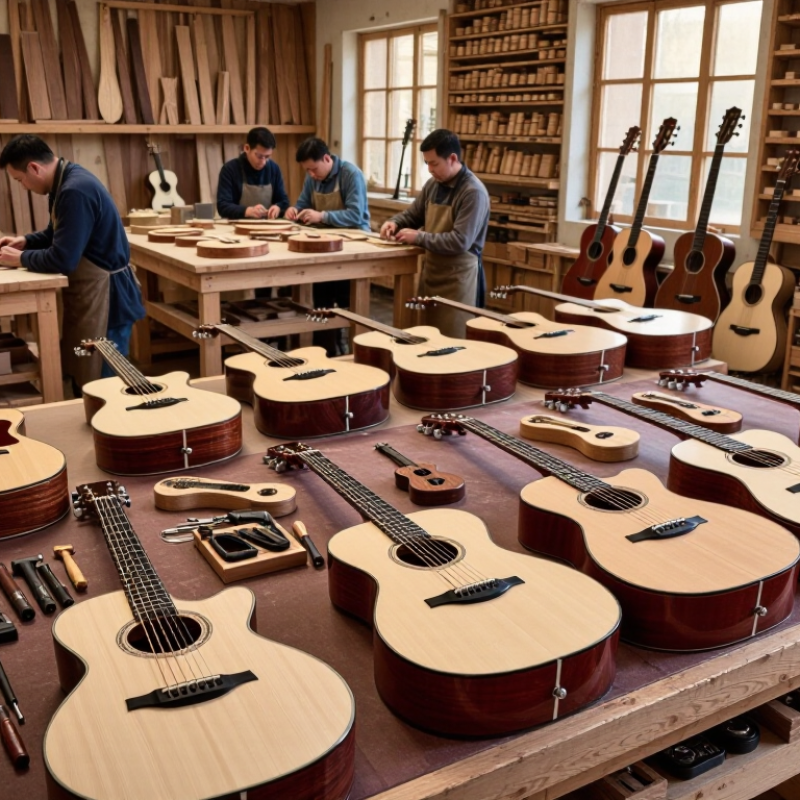
China’s acoustic guitar luthiery manufacturers turn design specifications into instruments through material selection, machining, assembly, finishing, and inspection. Their work often includes matching top-plate thickness to the body design, shaping braces, setting neck angles, and checking fret height. Small adjustments matter. A neck that is slightly misaligned can affect playability, even when the finish looks flawless.
For market context, Fortune Business Insights valued the global guitar market at about US$10.3 billion in 2023 and forecast growth to US$16.15 billion by 2032. That broad figure covers more than acoustic instruments and does not measure Chinese workshop quality. Buyers should therefore assess factory capability directly: ask for wood-moisture records, neck-relief tolerances, finish specifications, and inspection criteria. Request sample instruments from different production runs, not just a carefully prepared showroom piece. Still, measurements cannot fully capture tone. That is a real limitation.
A capable luthiery partner can translate a buyer’s target sound, budget, and order volume into practical construction choices. It may recommend solid wood, laminated sides, or different bracing patterns, while explaining trade-offs in stability, weight, and cost. UN Comtrade’s product-level trade data can help buyers examine musical-instrument export flows, but its broad categories do not isolate acoustic-guitar craftsmanship. Verify details on the factory floor. A written specification helps, though it may not catch every tonal inconsistency.
| Manufacturing Area | Typical Work | Buyer-Checkable Details | Why It Matters |
|---|---|---|---|
| Product engineering | Developing or adapting body shapes, neck profiles, scale lengths, and construction drawings for acoustic guitar models. | Request dimensioned drawings, approved specifications, and a pre-production sample for comparison. | Clear specifications reduce differences between the approved design and production instruments. |
| Wood selection and preparation | Selecting and preparing tonewoods and other structural woods for components such as tops, backs, sides, necks, and bracing. | Confirm the stated wood species, component grades, sourcing documentation where applicable, and the supplier’s moisture-control process. | Wood choice and moisture management affect stability, appearance, weight, and acoustic response. |
| Component machining | Cutting and shaping parts, often with templates or CNC equipment, then preparing components for assembly. | Ask how critical dimensions are checked and how revisions to drawings are controlled. | Consistent dimensions help parts fit together and support repeatable production. |
| Top bracing and body assembly | Fitting and gluing internal braces, joining the top and back to the sides, and forming the body structure. | Review the bracing layout, glue-joint inspection method, and sample construction before approving a production run. | Bracing and assembly influence structural strength, vibration, and long-term reliability. |
| Neck and fretwork | Shaping and attaching the neck, installing the fingerboard and frets, and preparing the neck for setup. | Agree on scale length, neck-joint design, fingerboard specifications, fret condition, and acceptable setup measurements. | Neck geometry and fretwork affect playability and the instrument’s ability to hold a usable setup. |
| Finishing and detailing | Sanding, applying the specified finish, and fitting decorative or functional hardware and components. | Specify finish type, color reference, sheen, cosmetic standards, and hardware requirements in writing. | Documented requirements make appearance and component checks more consistent. |
| Setup and quality control | Inspecting the instrument and checking items such as tuning, action, intonation, fret condition, and visible defects. | Request a written inspection checklist, sample acceptance criteria, and records tied to the production batch. | Defined checks make it easier to identify defects and assess whether instruments meet agreed specifications. |
| OEM and private-label production | Manufacturing to a buyer’s approved design or specifications, which may include packaging and labeling requirements. | Confirm tooling ownership, design-change approval, packaging details, labeling rules, and responsibility for compliance checks. | Written agreements clarify responsibilities and help protect product consistency across repeat orders. |
| Sampling and production planning | Preparing prototypes or pre-production samples, then scheduling manufacturing after specifications are approved. | Agree on sample sign-off, order quantities, lead-time assumptions, and how changes affect schedule and cost. | Approval milestones help buyers evaluate the actual build before authorizing larger production quantities. |
Capabilities and processes vary by factory and order. Confirm specifications, documentation, samples, and inspection criteria directly with each prospective manufacturer.
Workshops prepare wood, brace the soundboard, assemble the body, fit the neck, and complete setup. Small steps matter.
Wood shrinks as it dries below its fiber-saturation point. Parts need time to acclimate before gluing.
No. Tapping can reveal uneven response, but it is subjective. Measurements and inspection still matter.
Check fret leveling, string height, tuning stability, finish, and buzzing. Inspect the fret ends closely, too.
Ask about moisture control, neck dimensions, finish thickness, and batch consistency. Request measurements from a sample.
Confirm body shape, wood, scale length, bracing, finish, packaging, color variation, and inspection standards in writing.
Yes. Some changes can complicate setup or repair. I still find this easy to overlook.
Request a dated schedule, carton dimensions, protective packaging details, shipping terms, and clear plans for documents and delays.
This article explores the role of Acoustic Guitar Luthiery manufacturers in China, from selecting tonewoods and shaping components to assembling, finishing, and inspecting each instrument. It explains how workshops combine skilled handwork with modern tools to produce guitars for different playing styles and price ranges. Readers will learn what distinguishes leading manufacturers, including their craftsmanship, consistency, material choices, production capabilities, and ability to meet specific design requirements.
The article also offers practical guidance for evaluating luthier skills and product quality through sample instruments, construction details, finish, playability, and quality-control processes. It outlines how buyers can compare suppliers by reviewing custom options, communication, order flexibility, production timelines, packaging, and export services. Together, these considerations help buyers make informed decisions and find a manufacturing partner suited to their product goals and purchasing needs.